Articulated dragon STL files are popular for one simple reason: they print in one piece and move right off the bed. However, they can fail quickly if your support settings are wrong. On the Bambu Lab A1 Mini, incorrect supports often cause fused joints, rough surfaces, or broken wings. (best support settings for articulated dragon STL Bambu Lab A1 Mini)
The good news is this: most articulated dragons do not need heavy supports. In fact, using too much support usually creates more problems than it solves.
Let’s break it down step by step.
Do Articulated Dragon STL Files Need Supports?
In most cases, no.
Many flexi dragon models are designed to print flat on the build plate. Because of that, they can bridge small gaps without extra help.
However, you may need supports if:
- The wings are angled sharply upward
- The dragon’s mouth is open with floating teeth
- The model is scaled above 150%
- Thin decorative parts hang in mid-air
If one of these applies, use minimal supports instead of full coverage.
best support settings for articulated dragon STL Bambu Lab A1 Mini
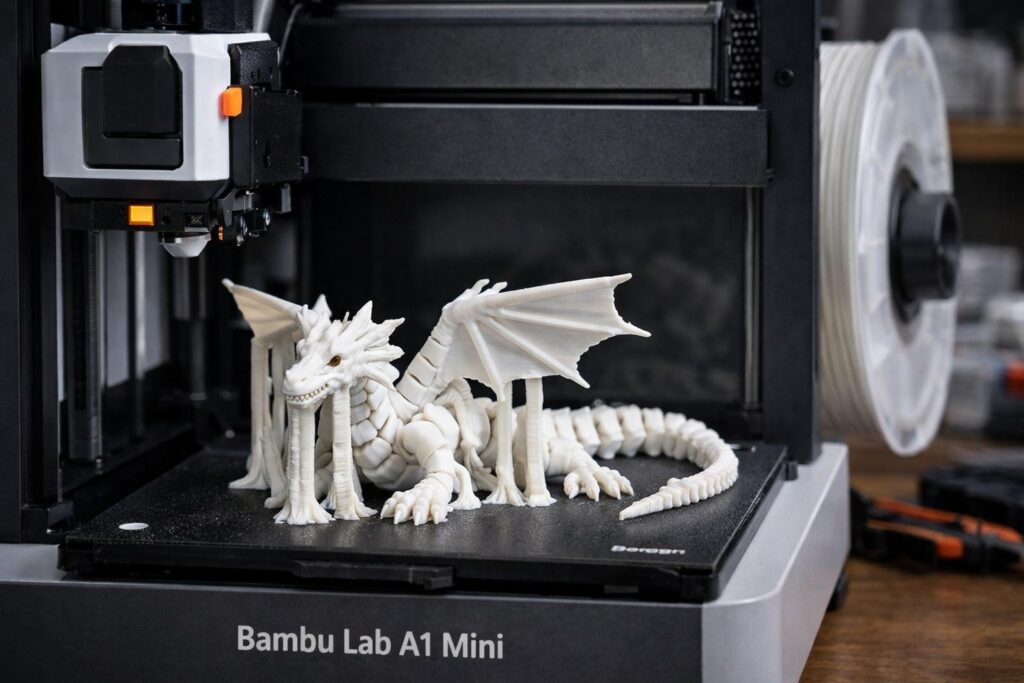
If supports are necessary, use the following settings for clean and removable results:
Support Type: Tree (Organic)
Tree supports touch the model less. As a result, they leave fewer marks and are easier to remove.
Support Placement: Touching Build Plate Only
This is critical. Never use “Support Everywhere” for articulated dragons. Otherwise, supports can fill the joints and lock the model.
Overhang Threshold: 55°
Lower values generate unnecessary supports.
Support Density: 10–12%
Low density is enough for wings while keeping cleanup easy.
Z Distance: 0.2 mm (for PLA)
This creates enough space so supports break away cleanly.
Common Mistakes to Avoid
Many failed prints happen because of simple setting errors. Avoid these:
- Using Grid supports instead of Tree
- Setting support to “Everywhere”
- Choosing a Z distance that is too low
- Increasing support density too much
If your dragon’s joints do not move, supports are usually the reason.
Can You Print Without Supports?
Yes, often you can.
If the model is well designed, try printing without supports first. Keep cooling at 100%. Lower your outer wall speed below 150 mm/s. Use 0.2 mm layer height and 3 outer walls.
In many cases, this is enough for a clean and fully articulated result.
Final Thoughts
When printing articulated dragon STL files on the Bambu Lab A1 Mini, the goal is simple: use the least support possible. Tree supports with “Touching Build Plate Only” offer the best balance between stability and clean removal.
With the right setup, your dragon will print smoothly and move freely right off the build plate.
You can download free stl files here!